
Support 6033 6005 5977 5975 5970 5921
Resistance 6058 6069 6097 6188 6203
Market Summary for 25th February 2016
The futures had been creeping up all night so the FT100 opened with a bit of a bang helped on by Lloyds which surged 13.5 percent after announcing a special
dividend payment and higher profits. The ex-dividend adjustment of 6.3 for the index did little to dent the up move.
Today it was one of the busiest days for corporate earnings in Europe and positive results helped support markets.
Oil surged by $1.50 at around 6pm UK time so this helped out of hours trading of the FT100.
Commentators are becoming more positive about the stock markets especially in the UK and Europe but whether this feeds through to continued support is unknown.
The strongest sector was banking largely on the back of results from Lloyds and as usual gold shares lagged as they tend to be counter cyclic to economic sensitive shares.
US & Asia Overnight from Bloomberg
Asian stocks rallied, on track for their second straight weekly gain, with China’s central bank saying it sees room for monetary easing as Group of 20 finance chiefs discuss stimulus efforts. Oil headed for the biggest weekly rise since August.
The regional benchmark is on track for a weekly climb of 0.6 percent, after the Standard & Poor’s 500 Index reached levels last seen at the start of 2016 on Thursday. Industrial metals rebounded and high-yielding currencies jumped, with the New Zealand dollar and the South Korean won strengthening. Gold extended gains.
The focus Friday is on the G-20 meeting in Shanghai, with People’s Bank of China Governor Zhou Xiaochuan saying he still has monetary policy tools at his disposal and there is no reason for yuan depreciation. U.S. Treasury Secretary Jacob Lew said earlier this week that an “emergency response” shouldn’t be expected from the group despite market gyrations. Global equities are set for their second straight weekly advance as oil maintains its rebound from an almost 13-year low reached earlier in February. The yen, a haven asset, is set for its first weekly drop this month.
“Markets this year have been driven by China, oil and currencies,” said Masayuki Doshida, a senior market analyst at Rakuten Economic Research Institute. “We should see stocks attempt a recovery today.”
New home prices in China rose in more than half the cities the government monitors amid moves by authorities to loosen property curbs in regions. Japan’s core inflationwas zero in January as low energy prices disrupt efforts to increase living costs.
Stocks
The MSCI Asia Pacific Index gained 0.7 percent as of 1:26 p.m. Tokyo time, as the Topix index in Tokyo was 0.8 percent higher and the Kospi index in Seoul climbed 0.2 percent. Hong Kong’s Hang Seng Index rallied 1.6 percent, the Straits Times Index surged 1.2 percent, the Jakarta Composite advanced 1 percent, while the Shanghai Composite was up 0.4 percent.
In making his second public appearance in a week following months of silence as officials try to soothe anxiety over China’s currency, Zhou said China’s economy remains strong and its structure and quality is improving. The PBOC separately published a statement defining current policy as “prudent with a slight easing bias.”
“The central bank chief’s comment has eased market concerns a bit and the overall liquidity condition is still going to be loose,” said Wei Wei, an analyst at Huaxi Securities Co. in Shanghai. “It looks like investor sentiment is fragile so the market isn’t likely to stabilize soon. We are going to see volatile trading.”
Standard & Poor’s 500 Index futures were little changed, after the index surged 1.1 percent on Thursday to its highest level since Jan. 6. Banks and technology shares drove the gain, with oil’s return to around $33 a barrel supporting energy producers.
Currencies
The kiwi jumped 0.7 percent, bringing its climb in the week to 2.1 percent, after New Zealand unexpectedly posted its first trade surplus in eight months for January. The won climbed 0.2 percent and Singapore’s dollar strengthened 0.1 percent. The yuan was little changed at 6.5363.
The yen was little changed at 112.84 per dollar and was heading for a 0.1 percent weekly loss, while the euro rallied 0.4 percent against the dollar. Finance Minister Taro Aso said Friday that policy makers must cooperate to prevent a currency war.
“Markets are rallying ahead of the G-20 meeting, boosting risk assets,” said Mansoor Mohi-uddin, a senior markets strategist in Singapore at Royal Bank of Scotland Group Plc. “The risk is that investor sentiment is disappointed by the meeting’s outcome, leading to renewed strength of the yen.”
The pound added 0.3 percent to $1.4008. For the week, it has tumbled 2.8 percent, the most since May 2010. Prime Minister David Cameron announced a June 23 date for the referendum on a so-called “Brexit” last week.
Commodities
Gold rose for a fourth day, gaining 0.3 percent and is heading for the biggest monthly gain since January 2012.
Base metals rebounded, supported by Zhou’s comments in Shanghai, with nickel in London rising 1.1 percent and copper in New York advancing 0.5 percent.
Oil held most of its gains as Russia said talks with Iran are continuing before a planned producer meeting next month on a proposed output freeze amid a global glut.
West Texas Intermediate slid 0.4 percent to $32.94, paring an 11.1 percent gain for the week. Russia’s output cap with Saudi Arabia will need to be in place for a minimum of 12 months to support prices, Energy Minister Alexander Novak said Thursday. A meeting with Iranian Oil Minister Bijan Namdar Zanganeh is possible next month, he said. Iran, seeking to boost exports after sanctions were lifted, said the deal is “ridiculous,” while Iraq said a pact hinges on unified support.
Bonds
China’s benchmark 10-year bond yield was little changed at 2.905 percent, while the overnight money rate fell six basis points in Shanghai after the central bank stepped up injections in open-market operations. Japan’s benchmark 10-year yield was unchanged at minus 6.5 basis points after the CPI data, while the U.S. yield was little changed at 1.72 percent. [Bloomberg]
FTSE 100 Outlook and Prediction
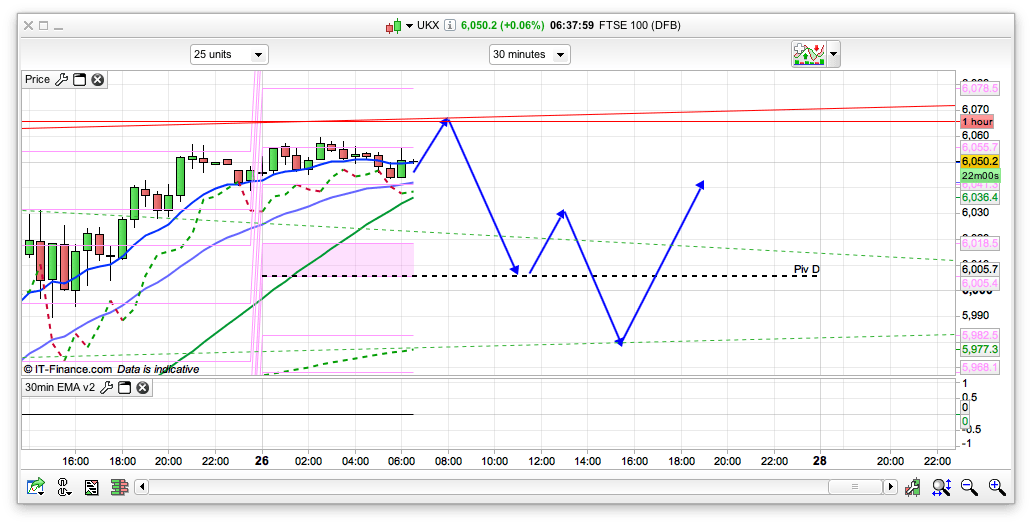
The bulls have managed to keep this rise above 6000 for the time being and things are looking positive on the expectation of stimulus measures at the G20 meeting. The bounce from 5500 has been pretty rapid and that dip to 5850 looks like the only pull back so far. For today we have the pivot at 6005 which I think might well get tested as initially the 10min chart is bearish with resistance at 6058. If we do get a pull back at all today and dip below the pivot then 5975 area looks a good long spot as there are a cluster supports around here as you can see from the list below, especially on the 2 hour chart. If this level does get hit and we bounce then we could well be on for a rise towards 6100 early next week. As I say its all mostly built on anticipation of stimulus measures that nay be forthcoming rather than anything too concrete as nothing much is different from when we were sliding down towards 5500. For the moment its buy the dips really, and ideally today will see such a dip to 5975. Its been a bit frustrating this week with just missed orders and just getting stopped on the Dax yesterday before it then rocketed up. The increased volatility messes up the automated trades!