
FTSE 100 Support 6884 6863 6824 6810 6793 6734 6731
FTSE 100 Resistance 6914 6929 6930 6956 6972
Good morning. Well so much for the NFP estimates! Coming well under at 151k, stock markets took off upwards, as the below expectation data reduced the chance of a rate hike in the US in September. The FTSE blasted up to 6930 (R3) before dropping back but closed the week strongly with high volume and at 6900. The G20 are meeting in China currently while North Korea has fired 3 ballistic missiles to get noticed! The US is closed today for Labor Day, so we may see a slow drift up on the FTSE today before a bit of a drop back tomorrow.
US & Asia Overnight from Bloomberg
Asian stocks rallied the most in eight weeks and higher-yielding currencies led gains against the dollar after weaker-than-expected U.S. jobs data kept a lid on speculation that the Federal Reserve will raise interest rates this month.
Raw-materials producers led gains on the MSCI Asia Pacific Index, while and Hong Kong’s Hang Seng Index climbed to its highest in a year. South Korea’s won advanced to a two-week high and New Zealand’s dollar appreciated for a fourth day. The yen strengthened following comments by the head of Japan’s central bank, while oil fell as the world’s two biggest producers stopped short of making concrete proposals to control output. Financial markets in the Canada, India and the U.S. are shut on Monday for holidays.
While Friday’s U.S. payrolls data showed hiring moderated more than economists forecast in August, the estimate of the number of jobs added in July was revised higher and investors still see a significant risk of a September interest-rate increase. The chance of the Fed hiking borrowing costs this month ended last week at 32 percent in the futures market, having been 34 percent on Thursday. The probability fell briefly to 20 percent in the wake of the data.
“The interpretation of the payrolls data is a bit mixed; it has missed expectations but it’s not terrible and it’s certainly above the run rate that is needed to keep the unemployment rate stable,” said Sim Moh Siong, a currency strategist at Bank of Singapore Ltd. “I’m still wary about the Fed tightening risk.”
China’s services output picked up in August, data showed Monday, and a comparable gauge for the euro area is also forecast to show improvement. Bank of Japan Governor Haruhiko Kuroda ruled out cutting monetary stimulus in a speech he gave in Tokyo and reiterated that there’s scope for existing policy tools to be loosened further if needed. Leaders of the Group of 20 nations are attending an annual summit, which is being held this time in Hangzhou, China.
Stocks
The MSCI Asia Pacific Index added 1.4 percent as of 1:04 p.m. Tokyo time. The Hang Seng Index rallied 1.7 percent, while benchmarks in Australia, South Korea and Taiwan rose the most in eight weeks. Japan’s Topix index added 0.8 percent as exporters advanced following Friday’s retreat in the yen. Toyota Motor Corp. climbed to its highest since February in Tokyo and Sony Corp. rose to levels last seen in November.
“The U.S. jobs data wasn’t something that greatly changed the outlook for a rate hike,” said Seiji Iwama, a fund manager with Daiwa SB Investments in Tokyo. “While expectations for monetary policy remained largely unchanged, we’ve gained more clarity on the situation with additional data, and the yen is weakening.”
Futures on the S&P 500 Index gained 0.2 percent, after the underlying gauge advanced 0.4 percent in the last session.
American employers added 151,000 workers to nonfarm payrolls in August, below the 180,000 projected by economists. The increase came in the wake of a jump in July that was revised up to 275,000. Richmond Fed President Jeffrey Lacker said Friday the message he took from the August data was that “labor markets are continuing to tighten.” He called the report “reasonably strong.”
Currencies
The Bloomberg Dollar Spot Index, a gauge of the greenback against 10 major peers, fell 0.2 percent after edging up 0.1 percent in the last session. The measure slid as much as 0.5 percent after the payrolls data, before reversing its decline.
“The disappointing August nonfarm payrolls report essentially reduced the risk or delayed a September fed funds rate hike,” said Elias Haddad, a senior currency strategist at Commonwealth Bank of Australia in Sydney. “That usually supports the risky assets like the high-yielding currencies” of Australia and New Zealand, he said.
The kiwi, which offers the highest yield among Group of 10 currencies, gained 0.6 percent, and Australia’s dollar rose 0.3 percent. South Korea’s won led gains in Asia with a 0.8 percent advance.
Japan’s yen was up 0.3 percent, after sliding 2 percent last week. Kuroda said Monday that some policy suggestions can’t be done legally or should not be done, such as directly underwriting government bonds and monetizing fiscal deficits.
Commodities
Crude fell as much as 0.9 percent in New York after Saudi Arabia and Russia stopped short of offering detailed plans to stabilize oil prices after Deputy Crown Prince Mohammed bin Salman and President Vladimir Putin met in China on Sunday. The price jumped 3 percent on Friday, the most in two weeks, after Putin said he’d like OPEC and Russia to agree to an output freeze and may propose the plan to the Saudi leader when they met.
Gold for immediate delivery declined 0.1 percent, after rallying 0.9 percent on Friday following the payrolls data.
Aluminum rose from its lowest close since July in London, while lead, tin and zinc traded near their highest levels in more than a year.
Bonds
Australia’s sovereign bonds due in a decade fell, pushing their yield up by five basis points to a two-week high of 1.90 percent. The nation’s central bank is forecast to keep the benchmark interest rate unchanged at Governor Glenn Stevens’s final policy meeting on Tuesday as policy makers hang on the U.S. Federal Reserve’s next move.
Japanese long-term bonds fell, with 30-year debt adding to its biggest weekly loss in almost 2 1/2 years, as investors prepared to bid at an auction of the securities Tuesday. The rout is being driven by speculation the Bank of Japan will reduce its bond-buying program at its next policy meeting now that it owns a third of the nation’s government debt. Kuroda said Monday he doesn’t share the view there’s a limit to monetary easing. “Unless Governor Kuroda directly rules out scaling back bond purchases, the market will continue to hold that as a possibility,” said Shuichi Ohsaki, the chief rates strategist at Bank of America Corp.’s Merrill Lynch unit in Tokyo. “Selling of longer-dated debt is likely ahead of tomorrow’s 30-year auction.”
The cost of insuring corporate and sovereign bonds against default in the Asia-Pacific region dropped the most in more than a week, according to prices from Nomura Holdings Inc. and data provider CMA. [Bloomberg]
FTSE 100 Outlook and Prediction
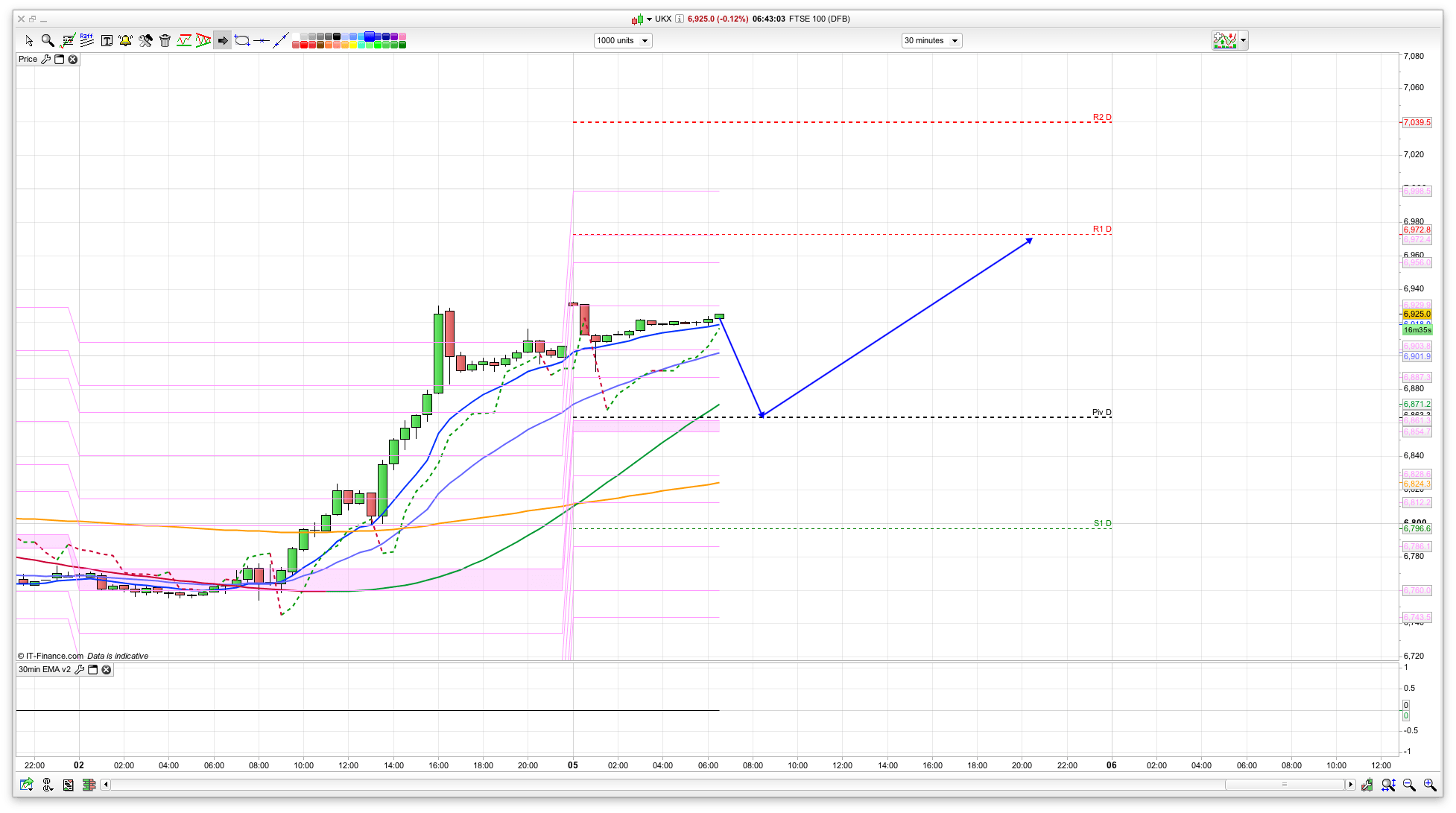
Usually, and I stress usually, if the US is closed we tend to have a fairly flat day, but after Friday’s antics we may well see a bit of a rise higher. However the bulls need to break the 6930 area of resistance first, which is where we dropped back from on Friday (so would be a double top) and we also have a fib level and the Raff channels for resistance here. The 2 hour chart (as you would expect) is now bullish again after that rise, with support at 6810 and 6793.
I have plotted an initial dip down to the pivot area at 6860 before another rise to the 6930 area and possibly higher for today. I am not sure that it will be so bearish that the 2 hour support areas get tested but if they do then the 6810/6815 area is worth a long. Not a lot of high impact news today, though we do have the UK PMI later this week.
So fairly simple plan really, with 6930 being the key resistance level, and 6865 then 6810 as support.