
Good morning. Slightly flat day yesterday, obviously not buying into the DAX exuberance, which rose a couple of hundred points virtually non stop! The S&P managed to hold the crucial support level at 2040, and the FTSE 200EMA on the daily, again around 6700 also managed to hold. Are we about to see a bounce? We have now had the EMA cross not he daily to bear, so the bulls will encounter resistance at 6850, which is the 25ema. The main news yesterday was on the forex with the EURUSD really looking like its heading to parity. Sterling’s strength could keep inflation low in conjunction with a tumble in the price of oil, says Martin Weale, a member of the Monetary Policy Committee.
US & Asia Overnight from Bloomberg
(Bloomberg) — Asian stocks rallied from a one-month low, while South Korean bonds climbed after the central bank unexpectedly cut interest rates. Gold led metals higher as the dollar weakened.
The MSCI Asia Pacific Index increased for the first time this week, adding 1 percent by 3:20 p.m. in Tokyo. The Shanghai Composite Index headed for a six-week high, while Standard & Poor’s 500 Index futures climbed 0.2 percent following a second day of declines in the U.S. gauge. The euro pared losses after touching a 12-year low and New Zealand’s dollar advanced after the central bank held rates. Gold rose for the first time in nine days and Korea’s three-year bond yield fell to a record.
South Korea’s surprise cut came a day after Thailand’s as central-bank easing outside the U.S. sends the dollar to multi-year highs against major peers. The European Central Bank’s 60 billion euro ($63 billion) a month bond buying program has sent the euro tumbling and dragged yields in the region to record lows. The U.S. reports retail-sales and jobless-claims data Thursday that may color expectations for next week’s meeting of the Federal Reserve.
“We’ve never seen stimulus created like this before and how you bleed that out is creating a lot of uncertainty as to what’s going to happen,” Michael Cuggino, president of Pacific Heights Asset Management LLC in San Francisco, told Bloomberg TV. “There’s such a divergence between what’s going on in the rest of the world with central banks cutting rates and the U.S. likely raising them. Still, there’s money to be made in stocks.”
Group Movers
Almost three stocks advanced for each that retreated on the MSCI Asia Pacific Index today, with nine of the 10 industry groups climbing.
Australia’s S&P/ASX 200 Index increased 1 percent after the country a reported lower-than-estimated 6.3 percent unemployment rate. The local dollar strengthened 0.4 percent to 76.25 U.S. cents after earlier trading near the almost six-year low of 75.61 cents struck yesterday. The number of people employed advanced by 15,600, erasing a revised drop of 14,600 in January.
Hong Kong’s Hang Seng Index rose 0.5 percent after yesterday closing at the lowest since Jan. 7. A gauge of Chinese companies listed in the city advanced 1.7 percent and the Shanghai Composite Index climbed 1.8 percent amid speculation the government may further ease monetary policy. China is due to release lending data for February by Sunday.
The euro retreated 0.1 percent to $1.0534 today, having weakened by about 5.9 percent versus the dollar this month. The joint currency touched $1.0495, the lowest since January 2003.
BOK Cuts
The Bloomberg Dollar Spot Index slipped 0.1 percent from a more-than 10-year high, its first decline in seven days. New Zealand’s dollar climbed 0.7 percent to 73.44 U.S. cents. The country’s central bank decided to keep the official cash rate on hold at 3.5 percent even as inflation slows to zero.
The Bank of Korea lowered the seven-day repurchase rate to 1.75 percent, as forecast by just two of 17 economists surveyed by Bloomberg, to prevent the nation from falling into deflation and support economic growth.
South Korea’s won weakened as much as 0.8 percent to 1,135.86 per dollar before trading at 1,127.85. The yield on three-year government bonds had been below the benchmark rate since March 3 and was last at 1.88 percent.
Yields on French 10-year notes fell below 0.5 percent for the first time yesterday and similar German notes paid a record-low 0.19 percent. Rates on German bunds with maturities out to seven years are less than zero.
Gold for immediate delivery lost as much as 0.4 percent before rebounding to $1,161.42 an ounce, according to Bloomberg generic pricing. The yellow metal touched $1,147.72 on Wednesday, the lowest level since Dec. 1 as the U.S. currency climbed, and another daily fall would complete the longest run of losses since January 1998.
Gold Forecaster
With the U.S. central bank indicating it will raise rates for the first time since 2006, bullion will post its third annual drop this year, according to Artur Passos, who produces the metals outlook at Itau Unibanco Holding SA, Latin America’s biggest bank by market value. Passos, part of a group led by former central banker Ilan Goldfajn, was the most-accurate among 20 forecasters, data compiled by Bloomberg Rankings show.
Aluminum in London rebounded from the lowest settlement in almost a year. The metal rose 0.9 percent to $1,760 a ton, climbing for the first time in five days. Copper, nickel and zinc for three month delivery on the London Metal Exchange advanced at least 0.7 percent.
West Texas Intermediate crude for April delivery was at $48.31 a barrel in electronic trading on the New York Mercantile Exchange. Brent added 1 percent to $58.12 a barrel in London.
Crude inventories increased by 4.51 million barrels to 448.9 million through March 6, the highest level in weekly data compiled since August 1982, the Energy Information Administration reported on Wednesday. The world oil market is oversupplied by 1 million to 1.5 million barrels a day, according to an official from Oman, the biggest non-OPEC producer in the Middle East.[Ref]
FTSE Outlook
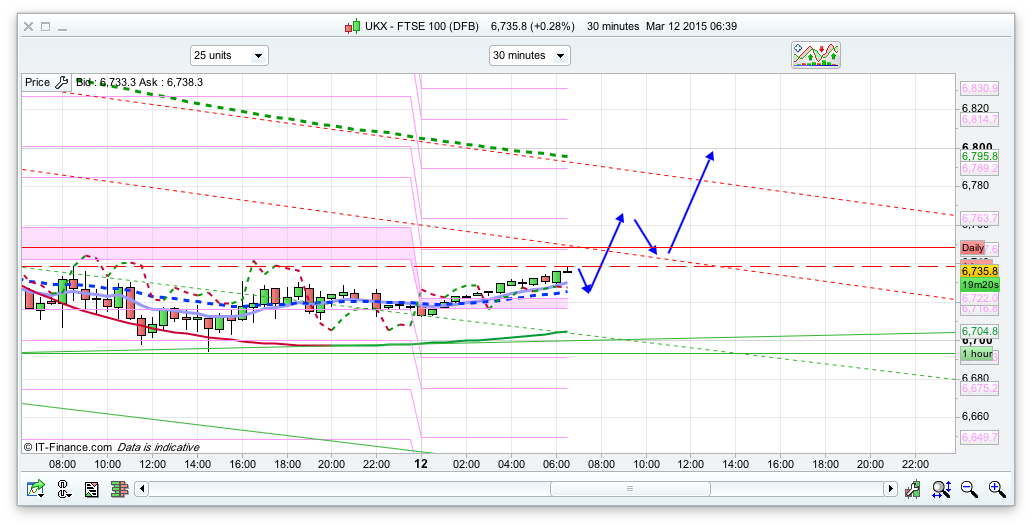
Well, I think we may have a bounce today as the 200ema on the daily has held 2 tests around the 6700 area and the 30min EMAs have finally crossed over to bull late last night and are looking a bit more positive for the bulls. Support today is initially at 6725, and i have put the stop just below the daily pivot which is 6718. If that does illicit a bounce then a rise to 6767 looks likely as long as the bus can break the 6738 area which was a bit of a barrier yesterday. As such I have an initial dip from there as we are currently testing it. Above this then we should get a quick rise to 6767, and then hopefully 6798 above that. Then we have the chance to push towards the 6850 area where we have the various daily resistances as mentioned in the trade plan below – 10 day Raff, 25ema, and also the top of the 10 day Bianca at 6873. As such I am still bullish for today after an initial pull back.
Support below the pivot is 6690 and then 6670. If the bears break this then I think we will see a decline towards 6500 as a bit of fear will once again spread through markets. If the bulls were to hold above 6825 then that changes the picture slightly but looking at the daily chart, shorting any rallies at 6850/6875 looks pretty sensible.