
Good morning. Slow rise to the 6799 yesterday for the FTSE, despite the Dax once again having a storming session, breaking 12000, stomping on the bears at that level and rising to 12220! The FTSE didn’t dip as low at the pivot unfortunately, but reached a high of 6820, so that is initial resistance today and again we have the 10 day Bianca in play, at 6835 resistance today. Coupled with the 10 day Raff, and 25ema at 6830, once again this whole area looks good for a short. Fairly quiet really on the UK news front yesterday with the main stories starting to be dominated by politics as the election gets nearer, and the final budget for this government this week as well. In the US though, factory production declined for a third straight month, and homebuilder confdence dropped something else to weigh on when to raise interest rates. Fed tomorrow should be interesting!
US & Asia Overnight from Bloomberg
(Bloomberg) — Asian stocks rose, after a rebound in U.S. equities, as weak economic data eased speculation the Federal Reserve will bring forward plans to raise interest rates.
The MSCI Asia Pacific Index gained 0.4 percent to 144.40 as of 9:02 a.m. in Tokyo. Factory production in the U.S. declined in February for a third straight month, data showed Monday, while confidence among U.S. homebuilders unexpectedly retreated this month to an eight-month low. The Standard & Poor’s 500 Index climbed 1.4 percent, the most in almost six weeks. The Fed starts a two-day meeting today, with investors watching whether the central bank removes a reference to being “patient” on rate increases from its statement.
“While the word patient may be taken away from the Fed statement, they won’t raise rates immediately since there are still signs of weakness in the U.S. economy,” said Hans Goetti Singapore-based head of investment for Asia at Banque Internationale a Luxembourg SA, which has about $36 billion in assets. “Given that the Bank of Japan and European Central Bank are still pursuing quantitative easing, it’s hard to see the U.S. raising rates immediately.”
Fed Chair Janet Yellen said last month the Fed’s pledge to be “patient” on starting to raise borrowing costs means an increase is unlikely for “at least the next couple” of meetings. Futures trading shows a 50 percent chance the Fed will boost its key borrowing costs to at least 0.5 percent by September, compared with 59 percent on March 6.
Japan, Indonesia
The Bank of Japan reports on monetary policy today, and Indonesia reviews rates, with most economists predicting they’ll be held after a surprise cut in February. The Reserve Bank of Australia publishes minutes of its last meeting, when borrowing costs were unexpectedly left unchanged.
Japan’s Topix index added 0.8 percent. South Korea’s Kospi index rose 0.7 percent. Australia’s S&P/ASX 200 Index gained 0.8 percent. New Zealand’s NZX 50 Index slid 0.1 percent. Markets in China and Hong Kong have yet to open.
Chinese stocks gained yesterday, with the benchmark Shanghai Composite Index climbing to its highest level since August 2009, after Premier Li Keqiang pledged to take action if economic growth slows too much and the benchmark money-market rate fell.
The Stoxx Europe 600 Index advanced to a seven-year high, as Germany’s DAX gauge topped 12,000 for the first time.
West Texas Intermediate crude for April delivery fell as much as 0.4 percent to $43.69 a barrel, heading for a sixth day of declines and extending a six-year low. U.S. government data due on Wednesday is forecast to show that crude supplies expanded to a record in the world’s biggest consumer.
FTSE Outlook
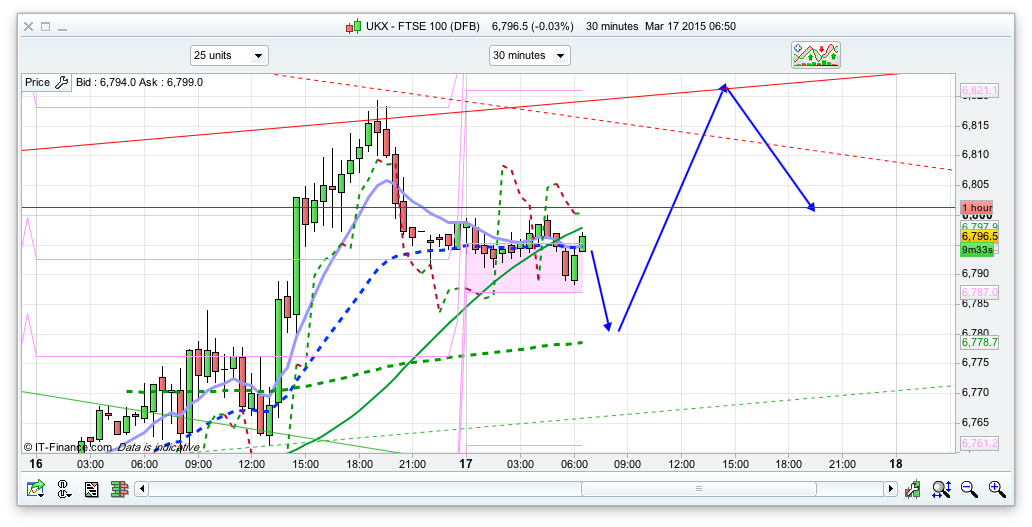
Yesterdays high at 6820 is initial resistance and as mentioned above there are a few resistance levels kicking around at 6830. With todays pivot at 6784, there is a fairly narrow range between them, and with a bit of weakness overnight we have the moving averages crossing to bear on both the 10 minute and 30 minute charts. Could be an interesting open as we are not far above the pivots. If we break 6830 today then the next levels of note are 6850, 6871 (top of 20 day Raff) and 6906 where we have the top of the 20 day Bianca. Support below the 6784 pivot is 6756 and then 6740. We do have the traditional bull Tuesday but last weeks was the exception to the rule – will we have a repeat of some bearishness today?