
Support 6026 6018 6015 5996 5989
Resistance 6047 6077 6082 6171
Good morning. The bulls didn’t really get much of a look in yesterday, and the latest poll put the leave camp ahead 53% to remain 47%, which helped the bears drive the FTSE 100 down from 6275 to 6220 as the poll results were released. There was a bit of optimism on the S&P with our 2090 long making some points, but apart from that, it was bearish across the board as Brexit jitters spook markets. You would think that the remain camp would point this out as a reason to stay!
US & Asia Overnight from Bloomberg
- Latest polls indicate British voters favor leaving the EU
- Ten-year yields sink to record lows in Australia, Japan
Risk aversion prevailed in markets, spurring a fourth day of losses in Asian equities as the U.K.’s upcoming vote on European Union membership fueled anxiety ahead of central bank meetings in the U.S. and Japan. The pound fell with oil, while sovereign bonds rallied.
An MSCI gauge of Asia-Pacific equities slipped to a three-week low and sterling resumed losses as new polls indicated more Britons favor leaving the EU than want to remain. The yen strengthened against all 31 major peers and yields on sovereign debt in Australia, Japan and New Zealand sank to records as haven assets attracted investors. U.S. oil extended declines below $49 a barrel, while gold retreated from near a four-week high.
Gauges of expected price swings in global stocks are surging and institutions including the International Monetary Fund have warned of dire fallout if the U.K. becomes the first country to leave the EU after a June 23 referendum. Monetary policy reviews by the Federal Reserve and Bank of Japan this week are adding to the potential for volatility in financial markets.
“The market is trying to price in Brexit and as a result there’s a flight to safety,” said Kelvin Tay, regional chief investment officer at UBS Group AG’s wealth management business in Singapore. “We’re now moving into a crucial period before the vote itself. Things are just going to get volatile from here on.”
The Fed begins a two-day policy meeting on Tuesday, with the futures market indicating zero chance of an interest-rate hike. The odds of a move by July have dropped to 16 percent, from 53 percent at the end of May. About 28 percent of 40 economists surveyed by Bloomberg predict the BOJ will expand its record monetary stimulus as soon as June 16, while 55 percent forecast more easing on July 29.
U.S. data on Tuesday are forecast to show retail sales advanced in May for a second month, indicating consumers are becoming less apprehensive about spending. Industrial output figures for the euro area are also due and the U.K. will report on inflation.
Stocks
The MSCI Asia Pacific Index fell 0.8 percent as of 1:07 p.m. Tokyo time, contributing to a four-day loss of 4.5 percent that marks its steepest slide since February. Australia’s S&P/ASX 200 Index dropped to levels last seen in April as trading resumed after a holiday on Monday, while Japan’s Nikkei 225 Stock Average slid to a two-month low.
The Nikkei Stock Average Volatility Index climbed to a three-month high after a similar measure for U.S. equities surged 23 percent on Monday, the most this year.
The Shanghai Composite Index declined 0.3 percent, after tumbling 3.2 percent on Monday, ahead of MSCI Inc.’s decision on whether to add China’s domestic equities to its global benchmark indexes. HSBC Holdings Plc estimates inclusion would initially spur inflows of as much as $30 billion.
Futures on the U.K.’s FTSE 100 Index declined 0.4 percent, after the gauge lost more than 1 percent in each of the last three trading sessions. S&P 500 contracts were little changed, after the U.S. benchmark fell 0.8 percent in the last session. U.S.-listed stock of Baidu Inc., China’s biggest Internet search engine, slid more than 5 percent in after-market trading as the company cut its sales forecast.
Currencies
The pound weakened 0.6 percent versus the dollar, approaching a two-month low. Four opinion pollsfrom three separate companies have put the campaign for Britain to leave the EU in front of the ‘Remain’ camp. The prospect of so-called Brexit actually coming to fruition pushed one-month implied volatility on the U.K.’s currency to levels last seen in November 2008, at the height of the global financial crisis.“Everything is about Brexit right now,” said Richard Falkenhall, a trading strategist at SEB AB in Stockholm. “Speculative accounts have added onto long dollars and long yen positions. At the same time people are adding to shorts in the pound and in the euro. When you watch the polls they’re tighter than they’ve ever been. So there is a lot of uncertainty out there at this point.”
The yen rose 0.2 percent, approaching a one-month high. Against the euro, Japan’s currency strengthened for a sixth day.
The dollar reasserted itself against some higher-yielding currencies, with New Zealand’s dollar falling 0.5 percent. The Bloomberg Dollar Spot Index, a gauge of the greenback versus 10 major peers, was little changed for a second session.
Bonds
Japan’s 10-year bond yield fell to an unprecedented minus 0.175 percent, Australia’s dropped as low as 2.05 percent and New Zealand’s slipped below 2.50 percent for the first time. Similar-maturity U.S. Treasuries were little changed after a five-day rally pushed their yield to 1.61 percent, the lowest closing level since 2012.
The cost of insuring Asia corporate and sovereign bonds against non-payment rose for a fifth day, the longest run of increases in 10 months, according to prices from Westpac Banking Corp. and data provider CMA.
Commodities
The Bloomberg Commodity Index fell 0.6 percent, retreating for the third time in four days. The gauge has rebounded more than 20 percent since sinking in January to its lowest level in a quarter century.
West Texas Intermediate crude dropped 1.1 percent to $48.34 a barrel, falling for a fourth day ahead of data on U.S. oil production and stockpiling. It reached $51.67 last week, the highest since July 2015.
Gold declined 0.3 percent, snapping a four-day rally in which it gained more than 3 percent. Zinc in London slid 1.2 percent, extending Monday’s retreat from a one-year high. [Bloomberg]
FTSE 100 Outlook and Prediction
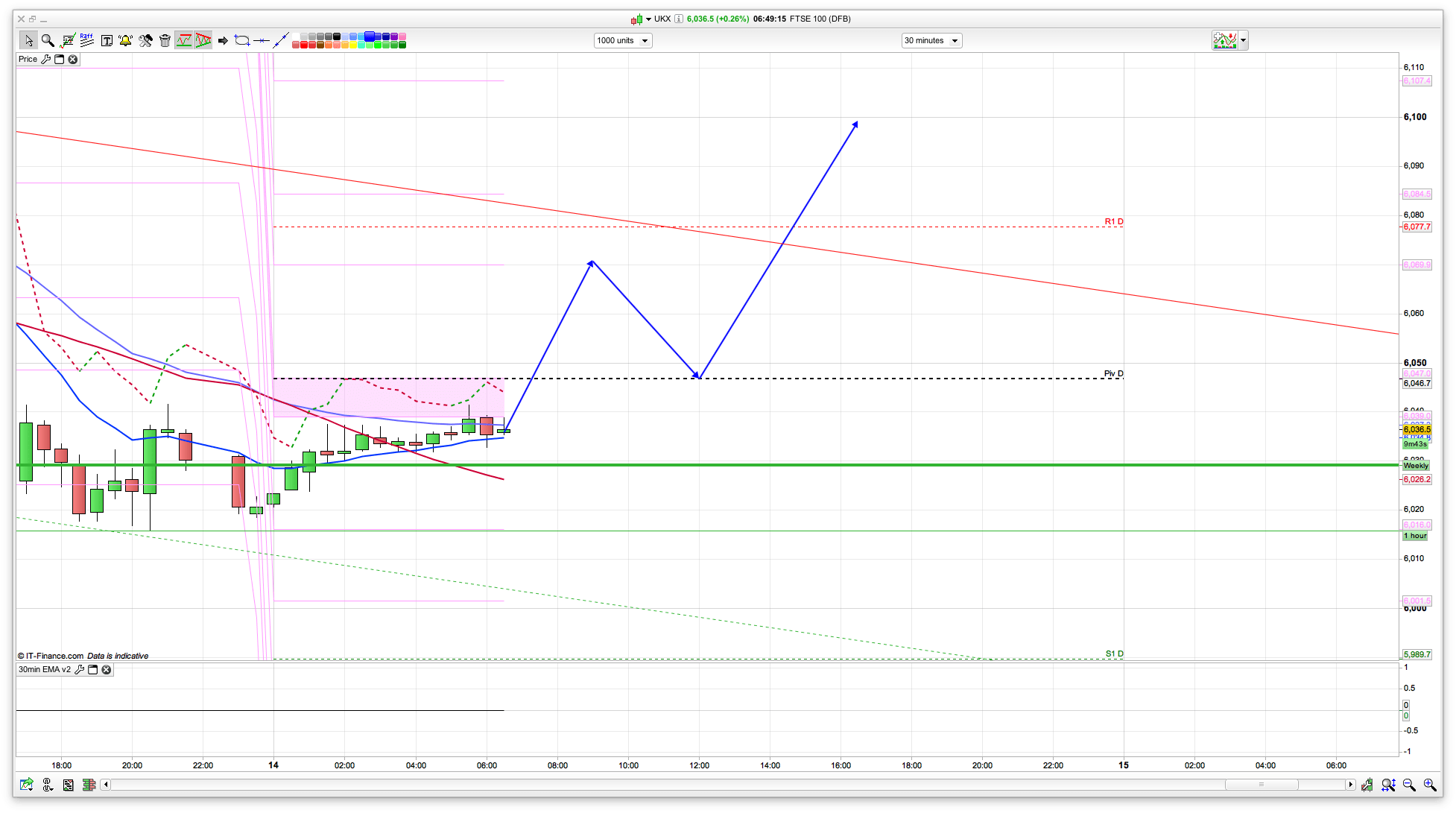
I was expecting that late break of 6030 yesterday to yield more bear points, but the bulls ended up defending it pretty well, only allowing the bears to get 6016 as the low, before bringing it back up to above 6030. Could be a bit of a make or break day for the bulls today, as if this 6000/6030 area does break then a fall to 5500 is distinctly possible over the summer. Pretty likely too if the leave camp win the referendum. For today I have gone for a bit of a positive session, with a rise to the pivot at 6047 initially, with 6077 above that, where we have a declining 30min channel and also R1.The bottom of the 10 day Bianca for today is 6018 and we have 20 day Raff channel support here too. The daily RSI(10) is also just moving back up through 30 (so shaking off a bit of oversold conditions) which is why I am thinking we might get a bit of a rise. I don’t think the bulls will be in charge for long though as the overwhelming trend and feeling is bearish. As resistance we also have the 100 Hull moving average on the 2 hour chart at 6082. If we were to break that 6080 area of resistance from a few different timeframes then 6170 is the next area of note. So, looking at the 6020 area as support, 6070 and then 6170 as resistance.