
FTSE 100 Support 6511 6505 6496 6440 6324
FTSE 100 Resistance 6587 6591 6597 6617
Good morning. Short indices and long gold worked well yesterday, just a shame the FTSE didn’t quite reach the sell order before dropping 120 points. Still, managed to tag the S&P and gold orders so not all bad. The Brexit fall out continues with the pound reaching $1.27 at one point – the lowest for 31 years. However, in the afternoon the bulls fought back across the board, with the FTSE up off its lows and back above 6500, as the pound going to $1.29. I feel the bounce will be short lived though as there is decent resistance on the 2 hour chart at 6587 so a short around here is worth a go for the next leg down.
US & Asia Overnight from Bloomberg
The yen strengthened for a third day and gold extended gains near a two-year high as the fallout from Britain’s vote to leave the European Union spurred demand for haven assets. Energy stocks led an advance in Asian equities as oil edged higher.
Japan’s currency rose versus all of its G-10 peers as its two-year bond yield sank to a record. Australia’s bonds retreated after S&P Global Ratings cut the outlook on the country’s AAA debt rating. Precious metals climbed after minutes of the Federal Reserve’s last policy meeting showed officials were losing confidence in the economy’s ability to withstand an interest-rate hike even before the U.K. referendum. The MSCI Asia Pacific Index gained for the first time in three days and futures on the FTSE 100 Index rallied as crude oil rose for a second day. Corn snapped a six-day losing streak.
Investor sentiment took a knock in the wake of the so-called Brexit vote and demand for haven assets got a boost this week as seven U.K. property funds froze withdrawals amid a surge in redemptions. Fed policy makers kept rates on hold at the June 14-15 meetingamid concern that job creation was faltering, the minutes showed. Officials said they were also awaiting the outcome of the British referendum, which roiled global markets in its immediate aftermath and continues to dog riskier assets. Business confidence in the U.K. is the weakest it’s been since 2011, a report showed Thursday.
“Ripple effects from the U.K.’s decision to leave the EU continue,” said Mitsushige Akino, a Tokyo-based executive officer at Ichiyoshi Asset Management Co. “The wait-and-see mood will continue with investors trying to gauge the impact.”
While services data Wednesday signaled the U.S. economy may have been gaining speed before Brexit, payrolls figures on Friday will be key to investors’ perceptions of where the Fed stands on its original plan to potentially raise rates twice this year. Germany and the U.K. have industrial output data due on Thursday and a report on British home prices is also scheduled. Financial markets in Indonesia and Malaysia are closed for holidays.
Currencies
The yen strengthened 0.4 percent to 100.92 per dollar as of 12:55 p.m. Tokyo time, taking its post-Brexit rally to more than 5 percent. Bank of Japan Governor Haruhiko Kuroda said in a speech to his bank’s branch managers Thursday that the country’s consumer-price index is likely to remain slightly negative for the time being. He also said he is monitoring risks and will add stimulus should it be required.
“The yen is gaining because it is the world’s preeminent safe-haven currency, and dipping below 100 per dollar again is only a matter of time,” said Joseph Capurso, a senior currency strategist in Sydney at Commonwealth Bank of Australia.
Australia’s dollar was little changed, after earlier sliding as much as 0.7 percent. S&P cut the outlook on the nation’s credit rating to negative from stable following an inconclusive general election result at the weekend. The ratings company said that “without remedial action the government’s fiscal stance may no longer be compatible with the country’s high level of external indebtedness.”
The British pound added 0.4 percent to $1.2977, after sinking to a 31-year low of $1.2798 on Wednesday. South Korea’s won rose 0.9 percent versus the dollar, gaining for the first time this week. The Bloomberg Dollar Spot Index, which tracks the greenback against 10 major peers, fell for a second day, declining 0.1 percent following a 0.2 percent drop on Wednesday. Futures put the probability of the Fed raising interest rates by December at 12 percent, down from 50 percent at the time of the U.K.’s June 23 referendum.The Fed minutes “play into our core view that the Fed will now delay a further rate hike until December, at the earliest,” Kymberly Martin, a markets strategist in Wellington at Bank of New Zealand Ltd., said in an e-mail to clients. “The market is certainly pricing in ‘gradual’ rate hikes.”
Commodities
Gold rose 0.3 percent, climbing for a seventh straight session and nearing $1,370 an ounce. The price reached $1,375.71 on Wednesday, its highest since March 2014. Holdings in bullion-backed exchange-traded funds topped 2,000 metric tons on Wednesday for the first time since July 2013, according to data compiled by Bloomberg. Silver advanced 0.3 percent, holding above $20 an ounce.
Crude oil rose 0.4 percent to $47.62 a barrel in New York, building on Wednesday’s 1.8 percent rebound. U.S. oil inventories fell 6.7 million barrels last week, the American Petroleum Institute was said to have reported ahead of government data Thursday that’s forecast to show supplies declined by 2.5 million barrels.
Corn, which entered a bear market on Tuesday, rallied for the first time in seven days. The price climbed 0.7 percent to $3.43 a bushel in Chicago.
Stocks
The MSCI Asia Pacific Index added 0.3 percent, with a gauge of energy stocks rallying 1.1 percent. Benchmarks fell in Shanghai and Tokyo, while Hong Kong’s Hang Seng Index advanced 0.8 percent. New Zealand’s S&P/NZX 50 Index climbed for a ninth day, its longest winning streak since March.
Samsung Electronics Co. gained as much as 2 percent in Seoul after the world’s largest maker of phones and memory chips reported better-than-estimated earnings. Geely Automobile Holdings Ltd. rose the most in a month in Hong Kong after the company reported a 41 percent jump in June sales and UBS AG upgraded its stance on the stock.
Futures on the S&P 500 Index declined 0.1 percent following a 0.5 percent increase in the U.S. benchmark on Wednesday, while contracts on the U.K.’s FTSE 100 Index rallied 0.9 percent. Economists predict Friday’s jobs report will show American employers added 180,000 workers to payrolls in June, following an unexpectedly small increase of 38,000 in May, the least in almost six years.
Bonds
The yield on Australian government bonds due in a decade rose by one basis point to 1.88 percent, after touching a record-low 1.84 percent on Wednesday.
Japan’s two-year bond yield fell one basis point to an all-time low of minus 0.345 percent. The nation’s 10-year rate was minus 0.275 percent, near the record of minus 0.285 percent reached on Wednesday.
The yield on U.S. Treasuries due in a decade declined one basis point to 1.36 percent, after sinking to an unprecedented 1.32 percent in the last session. Billionaire bond investor Bill Gross said Wednesday that sovereign bonds are “too risky” with yields in many developed markets near all-time lows. [Bloomberg]
FTSE 100 Outlook and Prediction
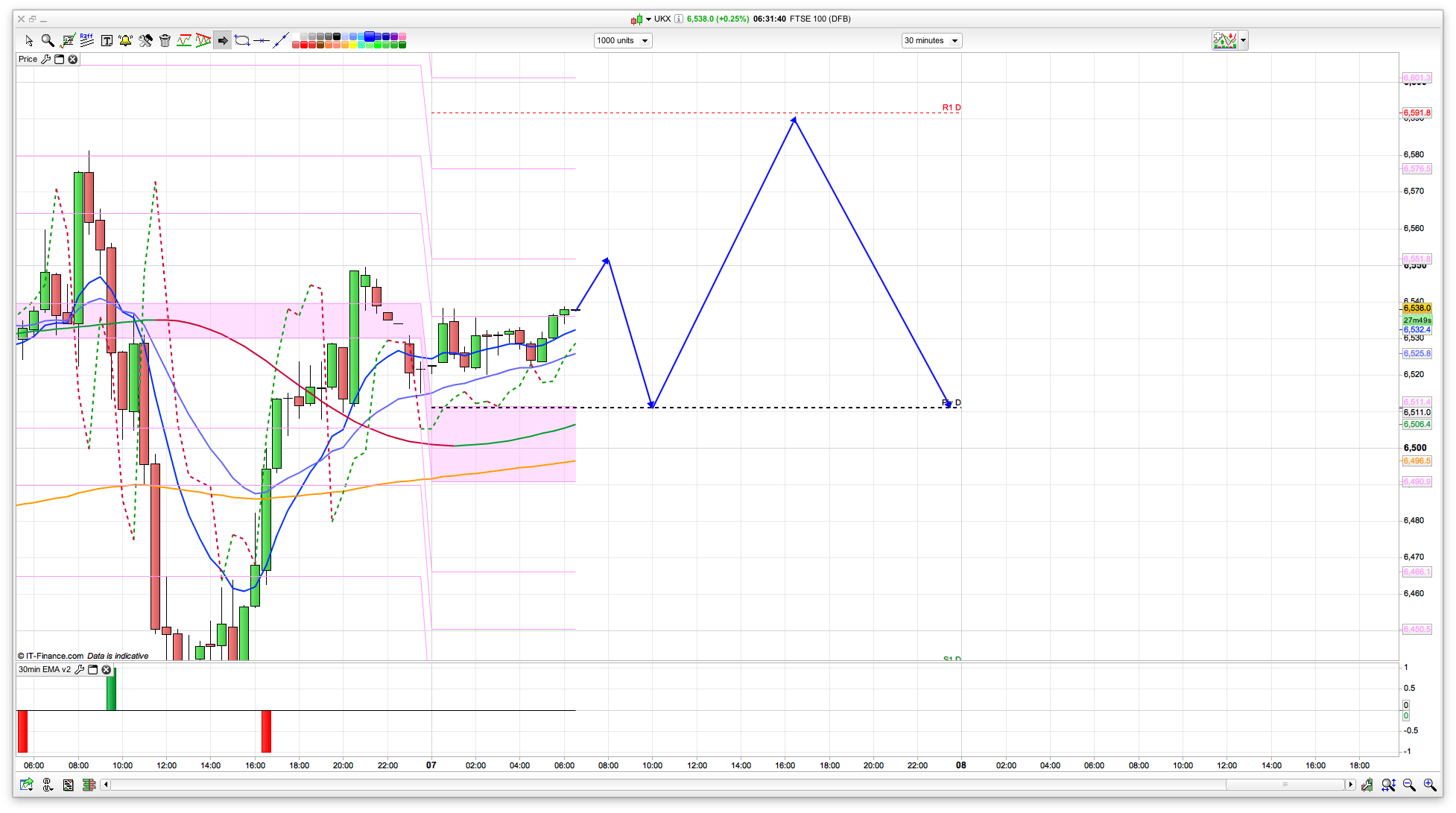
I am looking at the 6585 level to short from and the 6511 area to long from today, the former is 2 hour resistance and the latter is the daily pivot. So all in all, a fairly simple plan really, ideally looking to short from the 6585 area for a decent run down to test 6400 or maybe lower. We do however have NFP* news out tomorrow which could throw a spanner in the works – this is the delayed release from last week – as we may see some buy the rumour going on, as the forecast is 180k compared to the last dismal 38k.
Support wise we have the daily pivot, but also the 30min coral at 6506 and then the 200ema on the 30min at 6496 – so the bears will be keen to break this area today. After 2 sessions where we have had a fall then a bounce, we might well get a bit of the same again today. The S&P bulls will be keen to try and keep the S&P above 2100 as well.