
FTSE 100 Support 6900 6862 6861 6847 6803
FTSE 100 Resistance 6903 6915 6930 6935 6944
Good morning. Well the 6868 are ahead well as support yesterday (did go slightly below but the entry there worked well) and we got the rise to 6902, and then a bit more! Must admit I didn’t expect t be looking at 6935 yesterday, so the bulls were certainly turbo charged after the Fed’s rhetoric on Wednesday. However…. the bears appeared at that level and brought it back down towards 6900 – the key bit is that we closed above that level though, which means that the chance of a rise to 7000 is greatly increased. But not definite – there are just a few too many shouting about it to make it a bit more unlikely. After all, if everyone expects the same thing in the market it will rarely happen. Asia stayed pretty flat overnight, and indeed the FTSE 100 futures have hovered around the 6900 level.
US & Asia Overnight from Bloomberg
A rebound in global equities sputtered in Asian trading as the dollar strengthened and oil retreated from a two-week high. Bonds extended gains, buoyed by central bank commitments to keep monetary policies loose.
The MSCI Asia Pacific Index pared its biggest weekly rally in two months as Japanese shares retreated following a holiday. U.S. equity index futures were steady after the Nasdaq 100 Index closed at an all-time high. The yen and New Zealand’s dollar were the biggest losers among major currencies. Benchmark bonds rallied in Australia, Japan and New Zealand, while gold fell for the first time this week. Crude fell below $46 a barrel with investors weighing prospects for major producers to agree output constraints at talks next week in Algiers.
Stocks, bonds and commodities climbed this week and the dollar weakened as the Federal Reserve scaled back its plans for interest-rate increases in 2017 and beyond. Investor sentiment also got a lift as the Bank of Japan strengthened its commitment to reviving inflation at a policy review, while Indonesia cut interest rates for the fifth time this year and New Zealand’s central bank signaled further easing.
“There’s a very bullish case for equities considering that the Fed is now expecting only two rate hikes in 2017,” said James Woods, a strategist at Rivkin Securities in Sydney. “There are uncertainties that could shake up some volatility in the market, including the U.S. elections in November.”
Preliminary data pointed to a pickup in Japanese manufacturing this month ahead of the release of gauges tracking factory output and services activity in France, Germany and the euro area. Regional Fed chiefs for Atlanta, Cleveland and Philadelphia may comment on U.S. monetary policy when they appear as panelists at a conference on Friday.
Stocks
The MSCI Asia Pacific Index was down 0.3 percent as of 1:18 p.m. Tokyo time, trimming its weekly gain to 3.5 percent. Japan’s Topix index fell 0.3 percent, while Australia’s S&P/ASX 200 Index rose 0.9 percent.
The Hang Seng China Enterprise Index of mainland companies traded in Hong Kong gained 0.4 percent. It has rallied 14 percent this quarter, compared with a 3.8 percent advance by the Shanghai Composite Index — the biggest outperformance since 2011. Cheaper valuations, a stable currency, and the imminent start of a second exchange link with China are all lures for mainland investors who’ve flocked to buy Hong Kong stocks in recent weeks.
Futures on the S&P 500 Index were little changed after the U.S. benchmark rose 0.7 percent to a two-week high in the last session. The technology-heavy Nasdaq 100 Index advanced 0.8 percent on Thursday.
Currencies
The Bloomberg Dollar Spot Index gained 0.1 percent, trimming this week’s drop to 0.7 percent. The kiwi dropped 0.5 percent amid growing expectations that New Zealand’s central bank will cut interest rates at its next policy meeting in November.
The yen weakened 0.4 percent, trimming its weekly advance, after officials signaled they may intervene to counter appreciation and Goldman Sachs Group Inc. reiteratedits long-held view that the currency will fall. Japan’s Chief Cabinet Secretary Yoshihide Suga said Friday that moves in the foreign-exchange market have been very sensitive and policy makers are ready to react if the situation continues. A day earlier, the nation’s top currency official said speculative moves were undesirable and market activity was being closely monitored.
Bonds
The Bloomberg Global Developed Sovereign Bond Index was headed for its biggest weekly gain since July and Janus Capital Group’s Bill Gross said a bear market in government debt has been delayed by the actions of monetary authorities.
Bonds advanced across most of Asia on Friday, with China’s 10-year yield dropping to this month’s low of 2.73 percent. Rates in Australia and New Zealand fell to two-week lows of 2.01 percent and 2.42 percent, respectively. In Europe, Germany’s yield dropped on Thursday by the most since June, while Spain’s slid to an all-time low.
U.S. Treasuries due in a decade yielded 1.62 percent, little changed from Thursday and down seven basis points from a week ago. American government debt has handed investors an average return of 4.9 percent so far this year as the Fed refrained from adding to December’s interest-rate increase and former Fed Chairman Alan Greenspan said he expects the rally to be derailed by an expected pickup in inflation.
Japan’s 30-year bonds rose, pushing their yield down by six basis points to 0.46 percent. The move comes two days after the BOJ said it would shift the focus of monetary policy to shaping the yield curve, an adjustment that was seen driving long-term rates higher.
“People may fear the BOJ cannot control the yield curve,” said Yoshiyuki Suzuki, the head of fixed income in Tokyo at Fukoku Mutual Life Insurance Co., which has about $66 billion in assets. “I believe the BOJ desires a steeper yield curve, but they can’t guarantee it.’
Commodities
The Bloomberg Commodity Index fell 0.5 percent, its first decline in more than a week.
Crude oil slipped as much as 1.2 percent to $45.76 a barrel in New York. It’s still up more than 6 percent for the week and OPEC members Saudi Arabia and Iran are holding a second day of talks in Vienna before major producers meet Sept. 28 in Algiers to discuss ways to stabilize prices. The two nations’ rivalry derailed an oil supply accord earlier this year and Iraq’s OPEC representative said crude prices are unlikely to climb above $50 unless the group cuts production. “If there is an agreement, it’ll probably be a token deal where nations agree to a production cap near the upper limit of capacity,” said Ric Spooner, an analyst at CMC Markets in Sydney. “The market is still in surplus and hasn’t yet arrived at a balance.”
Gold declined 0.2 percent, trimming its best weekly advance since July. Efforts by the world’s top central banks to bolster growth including low or negative rates and asset purchases are driving demand for bullion as a store of value.
Most base metals retreated in London, after a 2.1 percent gain in the LME index on Thursday that marked the gauge’s biggest jump in two months. Nickel led losses with a 1.2 percent drop, while copper was down 0.5 percent. [Bloomberg]
FTSE 100 Outlook and Prediction
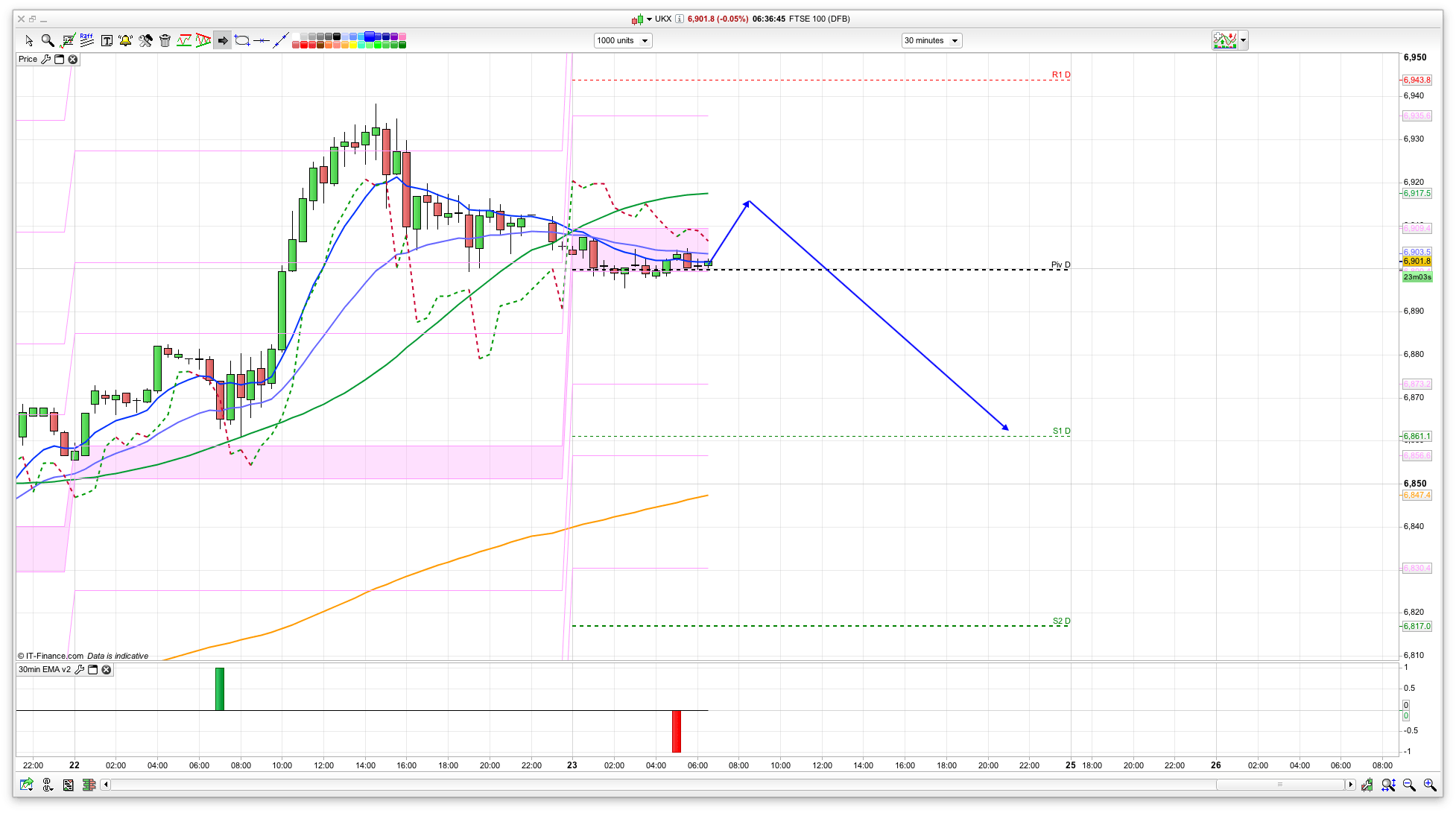
Friday after a fairly big week news wise, so I have just gone for a fairly simple trade – short off the 6915 level where we have the 100 Hull MA on the 2 hour chart and also the coral on the 30min (still green at the moment, but might go red around the open time). I don’t think we will rise towards 7000 today but may have a little dip back before we do. Its been a good run from 6640 (recent low) to this level, with 6 green daily candles on the trot, so a bit of profit taking today could well be likely. If that plays out then a dip down to S1 and the 200ema at 6860 level would be a good place to close. We also have the 2 hour coral for support at 6862 – so if this holds it could be the start of a climb towards 7000 next week.
If the bulls break 6915 then we will get yesterday’s high at 6935, where we also have the 20 day Raff, and then probably a bit higher – 6982 for R2 I am thinking. We might see 7000 today but i don’t think so.