
FTSE 100 Support 6884 6883 6875 6873 6826 6814
FTSE 100 Resistance 6940 6969 6990 7007 7034
Good morning, I hope you had a good weekend. Cant believe we are into Q4 of this year already – doesn’t time fly! Could be an interesting one too to close out the year, and ahead of the triggering of article 50 next quarter as is now going to be the case. At least the market will like the more definitive action plan. The FTSE 100 rebounded well on Friday, from the 6810 low, mainly driven by relief that Deutsche Bank might not be doomed, after their US fine was reduced. The bulls broke through both the resistance levels at 6868 and 6903, so now the momentum has swung back in their favour – choppy at the moment isn’t it!
US & Asia Overnight from Bloomberg
- German lender’s U.S. fine reported to be less than feared
- U.K.’s May says Brexit process to start by end of March
Asian stocks rose and regional bonds fell as concern about Deutsche Bank AG’s finances eased after the lender was reported to be lining up a less-costly settlement with U.S. regulators than investors had feared. Brexit angst weighed on the pound and oil declined.
Financial shares helped the MSCI Asia Pacific Index recoup more than half of Friday’s loss, after the S&P 500 Index advanced in the last session. Sterling slid versus most of its major peers after British Prime Minister Theresa May said she’ll start pulling the U.K. out of the European Union in the first quarter of 2017. Crude retreated from a six-week high as U.S. producers increased drilling, while New Zealand’s 10-year bond yield rose from a three-week low. Markets in China, Malaysia and South Korea were shut for holidays on Monday.
Relief spread across U.S. and European equity markets on Friday as Agence France-Presse reported that Deutsche Bank was nearing a $5.4 billion settlement with the American Department of Justice, less than half the amount initially sought in connection with a probe into mortgage-backed securities. The financial woes of Germany’s biggest lender as it struggles with tougher capital standards and soaring legal bills adds to a list of market risks that includes Brexit and tightening U.S. monetary policy.
“Investors were nervous about the uncertainty surrounding Deutsche Bank and the potential spillover effect on other European banks, but the mood is to take a wait-and-see approach for now,” said Yutaka Miura, senior technical analyst at Mizuho Securities Co. in Tokyo
Japan’s quarterly Tankan index of sentiment among large manufacturers came in slightly weaker than economists had expected, a report showed Monday. China’s official manufacturing purchasing managers’ index steadied at the highest level in almost two years and services picked up, data showed over the weekend. South Korea reported a bigger-than-expected drop in exports for September, ahead of the release of manufacturing gauges for the U.S. and the euro area.
Stocks
The MSCI Asia Pacific Index rose 0.6 percent as of 1:50 p.m. Tokyo time, after falling 1.1 percent in the last session. Financial shares accounted for about a quarter of the move, buoyed by Deutsche Bank’s 6.4 percent surge in Germany on Friday. The German lenders’ shares sank to a record low last week and are still down more than 50 percent from where they were a year ago.
“Concern about Deutsche Bank is far from over,” said Nicholas Teo, a strategist at KGI Fraser Securities in Singapore, said by phone. “Systemic risk is a real possibility with the derivatives exposure that plagues Deutsche.”
Australia’s S&P/ASX 200 Index climbed to a one-month high with trading volumes about 50 percent below their 30-day average amid holidays in states including New South Wales. Benchmarks in Hong Kong, Indonesia and Japan rose more than 1 percent.
Galaxy Entertainment Group Ltd. rallied more than 3 percent in Hong Kong after Macau reported a bigger-than-expected increase in its gambling revenue for September. China Overseas Land & Investment Ltd. slid to a two-week low after local governments in seven Chinese cities tightened home-buying rules. CapitaLand Ltd., Singapore’s biggest developer, fell as much as 1.9 percent after a report showed the city-state’s home prices dropped in the last quarter by the most in seven years. Kawasaki Heavy Industries Ltd. tumbled 11 percent in Tokyo after the company slashed its profit forecast.
Futures on the S&P 500 Index were little changed, after the underlying measure rallied 0.8 percent on Friday. Contracts on the U.K.’s FTSE 100 Index gained 0.2 percent.
Currencies
The pound dropped as much as 0.5 percent versus the dollar and lost 0.3 percent against the euro after May told delegates at her Conservative Party’s annual conference that she’ll invoke Article 50 of the EU’s Lisbon Treaty — the formal trigger for two-years of exit talks — by the end of March. Sterling tumbled the most on record to a more than 30-year low in the wake of the June vote in favor of Brexit.“We’re back to the Brexit risks,” said Vishnu Varathan, a senior economist at Mizuho Bank Ltd. in Singapore. “The sterling has taken a bit of knock first. If the concerns become wider concerns about financial market contagion we will find that the slight softening that we’ve seen in the dollar trend will be shaken off.”
New Zealand’s dollar weakened 0.3 percent before Fonterra’s Global DairyTrade whole milk powder auction on Tuesday. Milk is the South Pacific nation’s No. 1 export and prices fell when the fortnightly sale was last held on Sept. 20.
The offshore yuan was little changed at 6.6762 per dollar in its first trading session since the Chinese currency was added to the International Monetary Fund’s Special Drawing Rights on Saturday. Onshore markets are shut for all of this week.
Commodities
Crude oil fell 0.7 percent to $47.90 a barrel after rising 8 percent over the previous three sessions as OPEC members forged a preliminary agreement to reduce output. The number of rigs targeting crude in the U.S. rose for a fifth consecutive week, Baker Hughes Inc. said Friday. Iran wants to increase exports to 2.35 million barrels a day in the coming months, state news agency IRNA reported.
Gold was little changed after sliding 1.6 percent last week, the most since July.
Bonds
New Zealand’s 10-year bond yield rose by four basis points to 2.33 percent and Japan’s added one basis point to minus 0.075 percent. The rate on similar-maturity U.S. Treasuries increased by one basis point to 1.60 percent, after gaining three basis points on Friday. [Bloomberg]
FTSE 100 Outlook and Prediction
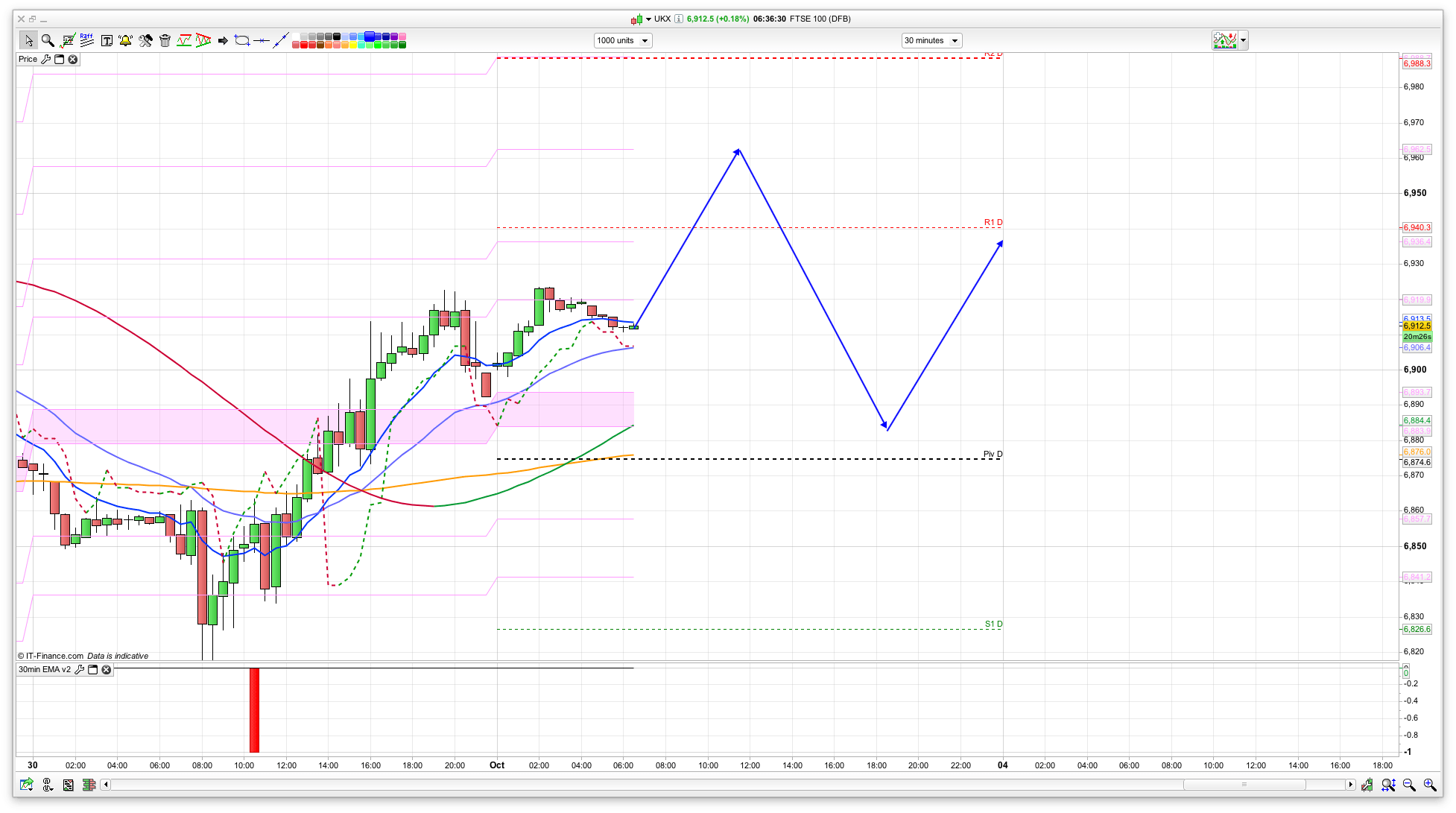
With the rise on Friday the bulls have some good support at around the 6875/6885 area for today. Its also essentially the start of the month so we ‘usually’ get a bit of a kick up as the new money flows in. There is resistance at 6969 where we have the 10 day Bianca channel, the 10 day Raff just below the 7000 level – a push to around these levels might result in some stutters, while the 20 day Raff is at 7035. The bulls will be keen on 7000 while they have the momentum. If we get an initial dip instead, down to the 6880 area then a long is worth it here I feel, but equally if this level breaks then flip to a short for a run down to 6826 where we have S1. The 2 hour chart I am looking at is bullish for the moment, also with support at 6873 and 6883, hence my long bias from this area. I still think we will get a bigger leg down soon, but rather than it starting last week maybe we pop a bit higher first then drop. So, slightly confusing picture really, but am watching 6880 area to hold as support, and 6969 as resistance, with 6990 and 7030 above that.