
FTSE 100 Support 7002 6990 6970 6920
FTSE 100 Resistance 7045 7073 7089 7178
Good morning. Apart from an initial foray up to 7076 at the opening bell the bulls were not able to push on yesterday and indeed its starting to look like the bears might be finally wrestling control back. Sterling strengthened against the dollar during the day, though a slightly muted effect on the FTSE, but saw a slow steady decline down to 6990 overnight. As mentioned in yesterday’s missive, 6990 is fairly key – the bears need to break that to push lower, so the bulls will need to be quick out the blocks this morning to “rescue” their charge. The 2 hour chart is still bearish with resistance at 7073. Fed minutes last night would indicate that a December rate rise is still on their minds.
US & Asia Overnight from Bloomberg
- China outbound shipments fall for first time in seven months
- Fed minutes show decision to hold in September a close call
Asian shares slumped with U.S. stock futures and the yen reversed a decline against the dollar as an unexpected drop in Chinese exports spurred concern about the outlook for the global economy.
The MSCI Asia Pacific Index declined 0.6 percent, with shares in Hong Kong tumbling 1.1 percent, while futures on the S&P 500 Index lost 0.6 percent as of 12:28 p.m. in Hong Kong. Treasuries rose the most in two weeks amid demand for the safest assets. Thailand’s benchmark equity index headed for its lowest level since May. The yen climbed 0.4 percent against the U.S. currency, while the yuan weakened to a six-year low. Crude oil continued to decline, sliding 0.8 percent to below $50 a barrel.
Volatility is climbing as investors grapple with fresh evidence of a deepening slowdown in China, increasing bets on a U.S. interest-rate hike and uncertainty spurred by Britain’s vote to leave the European Union. Minutes of the U.S. central bank’s last meeting released Wednesday reinforced the case for tighter monetary policy before the end of the year.
“Poor export numbers spark concern about the rest of the world’s economic outlook,” said Andrew Clarke, Hong Kong-based director of trading at Mirabaud Asia Ltd. “Sentiment is already pretty pessimistic, with Brexit and the sterling, the yuan looking vulnerable, the property bubble in China, looming cash calls from mainland banks and of course, who becomes the next U.S. president.”
Currencies
The Bloomberg Dollar Spot index erased gains on the China trade report and was little changed in afternoon trading in Asia. The gauge had advanced to a seven-month high after the Fed minutes showed the decision to keep rates on hold was a close call. Odds on an increase in U.S. borrowing costs by the end of the year remain around 68 percent, according to Fed funds futures, up about six percentage points from a week ago.
The yen climbed to 103.78 per dollar after earlier touching 104.64, its weakest level since July 29. South Korea’s won extended declines versus the greenback Thursday, slipping 0.9 percent in a third day of losses. The country’s central bank held its key interest rate unchanged for a fourth month as policy makers kept a wary eye on soaring household debt and possible economic headwinds.
Stocks
Hong Kong stocks headed for a six-week low, with the Hang Seng taking its four-day loss to 3.4 percent. The Hang Seng China Enterprises Index dropped 1.3 percent, with Air China Ltd. and China Pacific Insurance Group Co. plunging more than 2.3 percent. The Shanghai Composite Index was little changed.
The Topix index fell 0.2 percent after erasing a gain of as much as 0.9 percent in the morning session. Toyota Motor Corp. and Suzuki Motor Corp. rose 0.1 percent and 2.8 percent, respectively, after announcing Wednesday they will be exploring a partnership. The Kospi index in Seoul dropped 0.6 percent, even as biggest stock Samsung Electronics Co. rallied 2 percent following a selloff sparked by the company’s withdrawal of its flagship Galaxy Note 7 smartphone. India’s Sensex slipped 0.9 percent as investors returned from a two-day holiday.
Thailand’s benchmark SET Index lost 1.4 percent, and is poised to enter a correction after falling more than 10 percent from an August high. The gauge has fallen every day this week after the royal palace said in a statement on Sunday that 88-year-old King Bhumibol Adulyadej’s condition was unstable. The king is a symbol of unity in Thailand, which has had 10 coups during his seven-decade reign. The baht has tumbled 2.3 percent this week, the most in a decade.Futures on the S&P 500 slipped 0.6 percent to 2,118 after the underlying benchmark eked out a 0.1 percent advance on Wednesday, rising from a one-month low. Shares of Wells Fargo & Co. climbed in extended New York trading after the bank’s chief executive officer, John Stumpf, stepped down amid a public outcry over fake accounts.
Bonds
Sovereign bonds advanced as China’s trade data sent investors toward safer assets. Benchmark U.S. 10-year yields slid three basis points to 1.74 percent, after climbing to the highest level since June on Wednesday. Australia’s 10-year yield dropped seven basis points to 2.24 percent. The yield also fell from its highest level since June in its first decline in almost two weeks.
China’s exports fell 10 percent in September from a year earlier, while imports declined 1.9 percent. Lackluster trade data may increase pressure on the yuan at the same time as new property curbs threaten the nation’s growth rate.
“The Chinese economy is going to be weaker,” said Kazuaki Oh’E, the head of fixed income at CIBC World Markets Japan Inc. in Tokyo. “There’s a flight to quality.”
Commodities
Oil extended its decline below $50 a barrel after U.S. industry data showed stockpiles grew and as differences emerge within OPEC over how members will share output cuts. West Texas Intermediate crude fell 0.8 percent to $49.80 a barrel, bringing its three-day drop to 3 percent.
Base metals slumped amid concerns over China’s economy. Nickel sank as much as 1.6 percent on the London Metal Exchange, reversing earlier gains. While metals have advanced into a bull market this year as China’s economy stabilized, signs of an export slowdown are now clouding the outlook for global demand.
Gold rose for a second day, and platinum rebounded after entering a bear market on Wednesday. Corn advanced following its steepest drop in a month, adding 0.4 percent with wheat. [Bloomberg]
FTSE 100 Outlook and Prediction
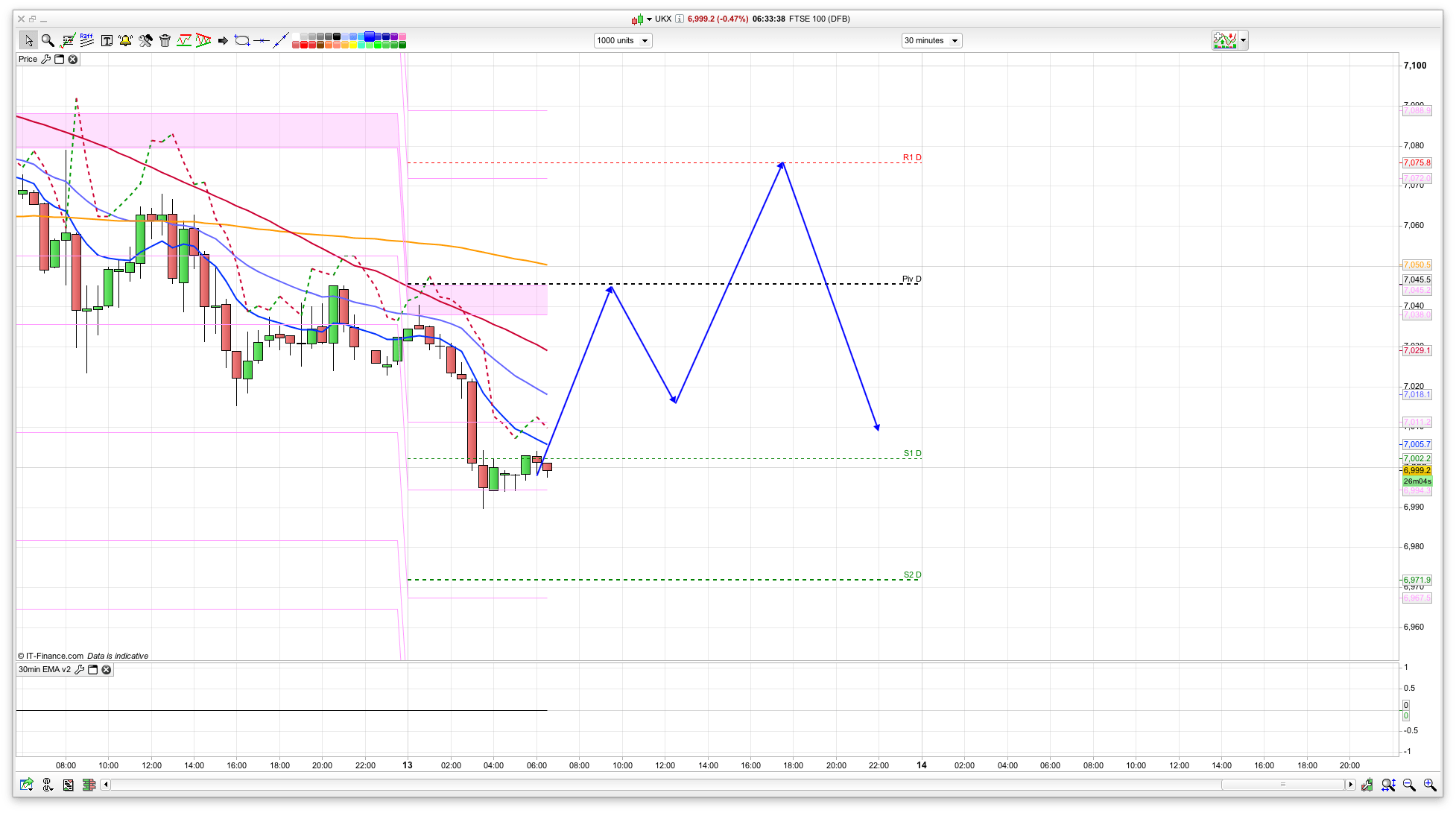
As mentioned yesterday I think shorting the rallies is still the best play, with the 7070 area looking a good entry point today, should it get there. It feels like the bears have finally managed to find a bit of strength after a couple of sessions of faffing around, probably while everyone has been watching sterling to see what that does and if a trip to 112 is going to happen again. Gold has started to rise from the 1250 level so the bigger picture play of short indices, long gold for the rest of the year seems to be starting to come to fruition. 7130 was tested twice and failed both times, so set up a decent double top pattern – if it were to get there again then it will probably break, but its a fair way away at the moment.
The bulls will need to hold 6990 initially, but if this breaks then 6970 is pretty key where we have S2 and also the 20 day Raff channel. This level is worth a long off but keep the stops tight – below this then there is a fair bit of fresh air – 6880 level is possible, with a brief pause at 6920. If the bulls do go for it then a rise to 7070 level would be ideal to get short from, though we have the pivot resistance first at 7045. Short from here and 7070 are both worth a go.