
FTSE 100 Support 6972 6968 6965 6950 6928 6927
FTSE 100 Resistance 7017 7020 7050 7061
Good morning. Interesting movement on the FTSE yesterday with the initial drop from the 7025 area as expected, then a sharp rally to 7068 and then fall back again and now sub 7000. Looks like it might have just been the market playing games to stop out a few early shorts before a big leg down…. especially as that price movement wasn’t replicated on the Dax and SP. The overnight weakness is off the back of disappointing Apple results, with the first annual sales decline since 2001. Is that steam train coming to a halt? Crude oil dropped and sterling is back below 122 – neither of which will help the FTSE bulls target 7130 again.
US & Asia Overnight from Bloomberg
Asian shares dropped with U.S. equity index futures as oil prices slumped and Apple Inc.’s results disappointed. Australia’s dollar strengthened after inflation data.
Energy companies led declines on the MSCI Asia Pacific Index, which retreated from a two-week high. Apple, the world’s largest company, fell as much as 3.1 percent in after-hours U.S. trading following its first annual sales decline since 2001. Crude oil sank to a three-week low after Russia said it wouldn’t join output cuts planned by OPEC, while aluminum surged in China. The Aussie rose by the most in a week and Australia’s two-year bonds fell as a pickup in consumer-price gains curbed speculation another interest-rate cut is coming.
“Plenty of countries want an exemption to the OPEC output cuts and that’s putting pressure on oil,” said James Audiss, Sydney-based senior wealth manager at Shaw and Partners Ltd., which oversees about $7.5 billion. “Apple’s forward expectations aren’t great and it’s susceptible to more of a pullback.”
Sliding prices for Apple iPhones and a forecast for lower-than-expected profitability over the holiday period cast a cloud over an earnings season that’s been generally positive, with about three-quarters of the S&P 500 Index companies to have reported so far beating estimates. Skepticism about major oil producers’ ability to agree output reductions continues to hang over financial markets, which nonetheless have become more settled as traders grow more confident about the outcomes of the U.S. presidential election and this year’s Federal Reserve policy meetings.
Bank of America Merrill Lynch’s GFSI Market Risk Index — a measure of future price swings implied by options trading on global equities, interest rates, currencies and commodities — has fallen to the lowest since 2014. Hillary Clinton’s odds of victory in next month’s vote are close to the highest on record at 86.5 percent, according to forecaster FiveThirtyEight, and futures trading indicates a 73 percent chance of a U.S. interest-rate rise by December.
Stocks
The MSCI Asia Pacific Index was down 0.3 percent as of 1:45 p.m. Tokyo time. Benchmark share gauges in Australia and South Korea slid by the most in six weeks, while the Shanghai Composite Index retreated from a nine-month high. Japan’s Topix index fluctuated after posting its best close since May on Tuesday.
Wesfarmers Ltd., Australia’s largest retail chain, tumbled by the most since 2009 in Sydney after sales at its Coles supermarkets missed estimates. Great Wall Motor Co. plunged 11 percent in Hong Kong after China’s biggest maker of SUVs was downgraded by JPMorgan Chase & Co. and Nomura Holdings Inc. in the wake of earnings.
Bank of China Ltd., Nintendo Co. and Posco are among Asian companies reporting results Wednesday. Outside of the region, the lineup includes Tesla Motors Inc., Coca-Cola Co., Bayer AG and GlaxoSmithKline Plc.
S&P 500 futures fell 0.2 percent, after the underlying gauge declined on Tuesday by the most in two weeks as data showed consumer confidence receded in the world’s biggest economy.
Commodities
Crude oil slid 1.3 percent to $49.31 a barrel in New York. Output cuts are not an option for Russia, the nation’s envoy to the Organization of Petroleum Exporting Countries said, according to Interfax. American supplies rose by 4.75 million barrels last week, industry data showed ahead of Wednesday’s release of official figures.
Aluminum in Shanghai jumped as much as 5.2 percent to its highest level since 2014, extending a rebound on speculation that transport bottlenecks may have created a shortage for some users in China. The metal rose 0.2 percent in London.
“There is a shortage of metal in the system right now,” Paul Adkins, managing director of consultancy AZ China Ltd., said by phone Nanning in southern China. “The cost of road freight has gone up and this has created a rail bottleneck in the aluminum provinces in the north ofChina. There appears to be a lot of metal stuck in warehouses.”
Gold rose for a second day amid speculation demand will strengthen in the run-up to this weekend’s Diwali festival in India, the world’s largest bullion-consuming country after China. It’s still down for the month and Oversea-Chinese Banking Corp., the most-accurate forecaster for the precious metal in the latest rankings compiled by Bloomberg, predicts the price will drop by about 14 percent to $1,100 an ounce by the end of next year as Fed rate increases boost the dollar.
Currencies
The Aussie strengthened 0.5 percent versus the greenback, the best performance among major currencies. Consumer prices in Australia increased 1.3 percent from a year earlier in the last quarter, exceeding the previous period’s 1 percent gain and the 1.1 percent rise forecast in a Bloomberg survey.
“A jump in headline inflation will help calm RBA fears over inflation expectations and thus means a steady hand on rates into year end,” said Sean Callow, a senior strategist at Westpac Banking Corp. in Sydney.
The Bloomberg Dollar Spot Index was little changed, after retreating 0.1 percent from a seven-month high on Tuesday.
Bonds
Australia’s two-year bond yield increased by three percentage points to a one-week high of 1.70 percent. The probability that the central bank will cut interest rates by mid-2017 dropped to 29 percent in the swaps market, from 37 percent on Tuesday.
The yield on U.S. Treasuries due in a decade declined by one basis point to 1.75 percent, trimming October’s increase to 15 basis points. American sovereign debt is saddling investors with losses for the third month in a row as speculation mounts that inflation will quicken and the Fed will boost interest rates.
“The cyclical low for inflation rates has almost certainty past,” said Peter Jolly, the global head of markets research at National Australia Bank Ltd. in Sydney, who predicts headline consumer-price gains in the U.S. will rise above 3 percent early next year if oil prices remain at current levels. “That will help change market perceptions of inflation ahead, and put to rest deflation fears for now.” [Bloomberg]
FTSE 100 Outlook and Prediction
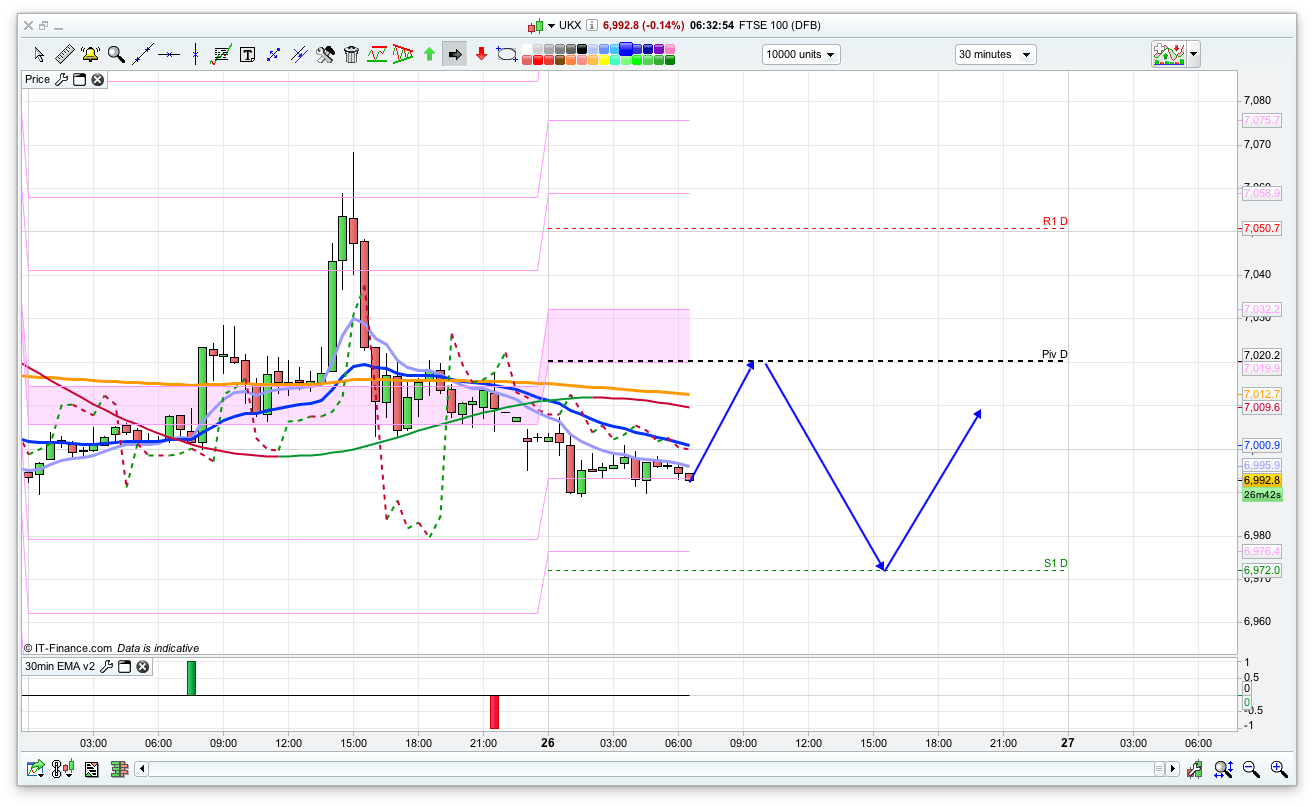
For today I am keeping my bearish vibe as the bulls really needed to close above 7055 yesterday to enable the basis for a push higher. We have a few resistance levels at the 7020 area so I think this is a good level to start with, if we get an initial rally. The bears will be keen to break below 6965 which is the bottom of the 10 day Bianca channel as that opens the possibility for a trip down to 6930 or lower. I don’t think it will be bearish enough today to dip to that level though.
If the bulls manage to break through 7020 then we could well be on for a test of yesterdays high level at 7070, a break of which keeps that 7130 and higher hope alive. Again, I don’t think we will see that extreme of price today.
We do have a few supports on the daily chart at the 6970 area in terms of the 25ema and the daily coral, so a break of this level would certainly start to make things look more bearish.